
At the bottom of this article, you will find the translation into the other working languages of the ILO.
Here at HQ, we’ve been moving since December 2025. Officially, it’s an office move: floor plans, boxes, sorting things out—for some, a migration from one floor to another; for others, a slight but significant shift.
But nobody is only moving offices.
Because beneath the labels, boxes, Planon and INFOTEC tickets lies the real question colleagues whisper about while discussing desks, having to share an office (something some haven’t done for years), or the size of the kitchenette: which areas of work will be prioritised—or deprioritised? Which committee has to review all RB funds, even your low-cost purchase of stationery? And, ultimately, where are we going: Turin? Doha? Or, scrap that: will my contract even be renewed?!
In uncertain times—inside and outside the organization—we find ourselves being moved physically, but also professionally and emotionally.
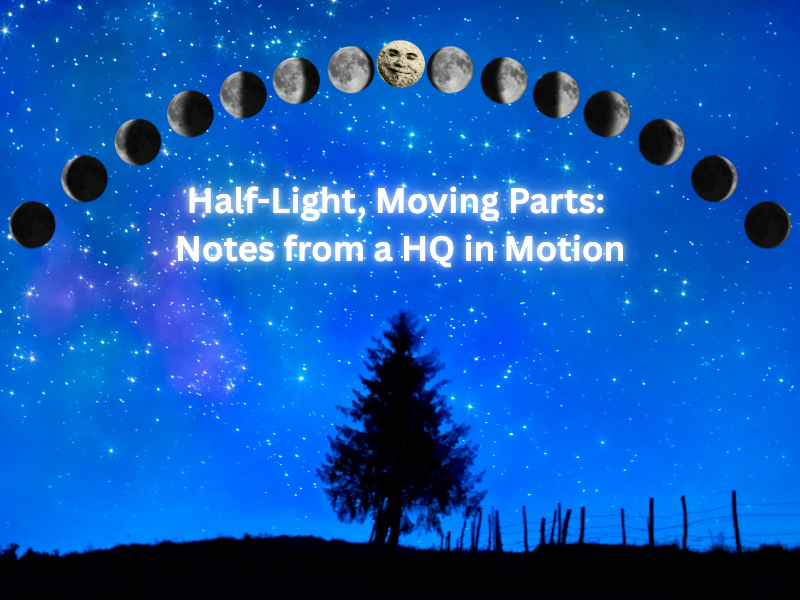
So let’s borrow a calmer calendar: the Moon[1].
A move that starts in December is a bit like working under a waning Moon: you’re already packing in the fading light, trying to stay steady while the world feels loud. Then came January’s New Moon—the sky’s way of saying, “There is a plan, even if you can’t see it yet.” A New Moon isn’t the absence of a Moon; it’s the moment the lit side turns away. The Moon is still there, doing its quiet work, pulling the tides, keeping its course. In other words: invisibility is not emptiness[2].
And now we head toward the next phase: the First Quarter—the half-lit Moon. It’s enough light to navigate, not enough to stop worrying. The phase of scaffolding: when you build with one hand and shield your eyes with the other.
That feels familiar.
Because we are being asked to be adaptable and patient, while also being efficient, optimistic, and “aligned.” We are told change is normal and necessary. We are also human, and humans don’t experience “normal” as comforting when the ground feels like it’s shifting and you’re not told clearly why. Colleagues aren’t only worried about where their desk will land and who they’ll share with—they’re worried about the ILO’s future, and then their own, in a world that is not short on turbulence.
A key compass has been the union-friendly reminder: uncertainty doesn’t become healthy just because it becomes frequent. Colleagues deserve clarity, not just resilience training. They deserve honest communication, not only cheerful slogans. They deserve to be treated as colleagues with futures, not as movable parts in the restructuring of the organization.
Still—this is not a doom forecast.
Moon phases are cycles. They don’t deny the dark; they promise it is not permanent. After the half-light comes more light. And hope, at its best, isn’t naïve, it’s practical: the hope that solidarity works, that transparency can be demanded, that change can happen without breaking the colleagues who keep the organization running.
So no, we can’t promise that the next phase will bring instant clarity or that every question will be answered before the next floor plan is updated (again). But we can insist on the basics: respect; information that arrives before rumours do via “Radio Moquette”; and decisions that treat colleagues as the organisation’s strength not just movable parts in a cost-saving exercise
And if the months ahead still feel like half-light: let’s keep our eyes on the path, our hands on the work, and our questions firmly unpacked. The Moon will wax. With enough collective pressure, so can clarity.
In solidarity as we continue into the next phase.
[1] https://spaceplace.nasa.gov/moon-phases/en/
[2] https://vocal.media/earth/what-is-a-black-moon-here-what-to-expect-this-week
Version française (deepl): ici
Spanish version (deepl): aquì